Live 1:1 Python classes · Usually from about 12
Python for kids: live 1:1 Python classes
Your child learns to type real code and makes games, drawings and data projects with it. One mentor for the whole level, at your child’s pace. Some 10- and 11-year-olds start sooner, once they’re ready.
Free 40-minute class, live and one-to-one. No payment. No card.
From the Educifly team: 500+ students taught one-to-one online.
Educifly teaches Python for kids in live, one-to-one online classes, for families anywhere in the world. Most children start Python at about 12, often after Scratch, apps or websites. In Level 8, they learn the basics by drawing with code and making small games. In Level 9, they build bigger games and work with real data. The first class is free.
Why should kids learn Python?
Python is a real programming language that reads almost like English. That makes it a good first typed language for most kids.
It’s also one of the most used languages in the world. Python has been ranked number 1 on the TIOBE Index, a monthly ranking of how popular programming languages are. People use it to make websites, games, data charts and AI tools.
Three more reasons we teach it:
It’s free. Python costs nothing to download and use.
It’s short. A program that draws a shape can be six lines long.
It leads to AI. Our Level 10 AI projects are written in Python.
Is my child ready for Python?
Most kids are ready for Python at about 12. Some 10- and 11-year-olds are ready sooner, once they read well, can type a little and have made things in Scratch. Age matters less than these signs.
Tick the ones that fit your child:
They read well on their own.
They can type short words without hunting for every key.
They’ve made a game or two in Scratch, or something like it.
They ask how “real” games and apps are made.
They can stick with a problem for 10 minutes before asking for help.
Three or more ticks? They’re likely ready. Fewer than three? Start with Scratch coding classes first. Either way, the mentor will tell you in the free class.
What does a child’s first Python program look like?
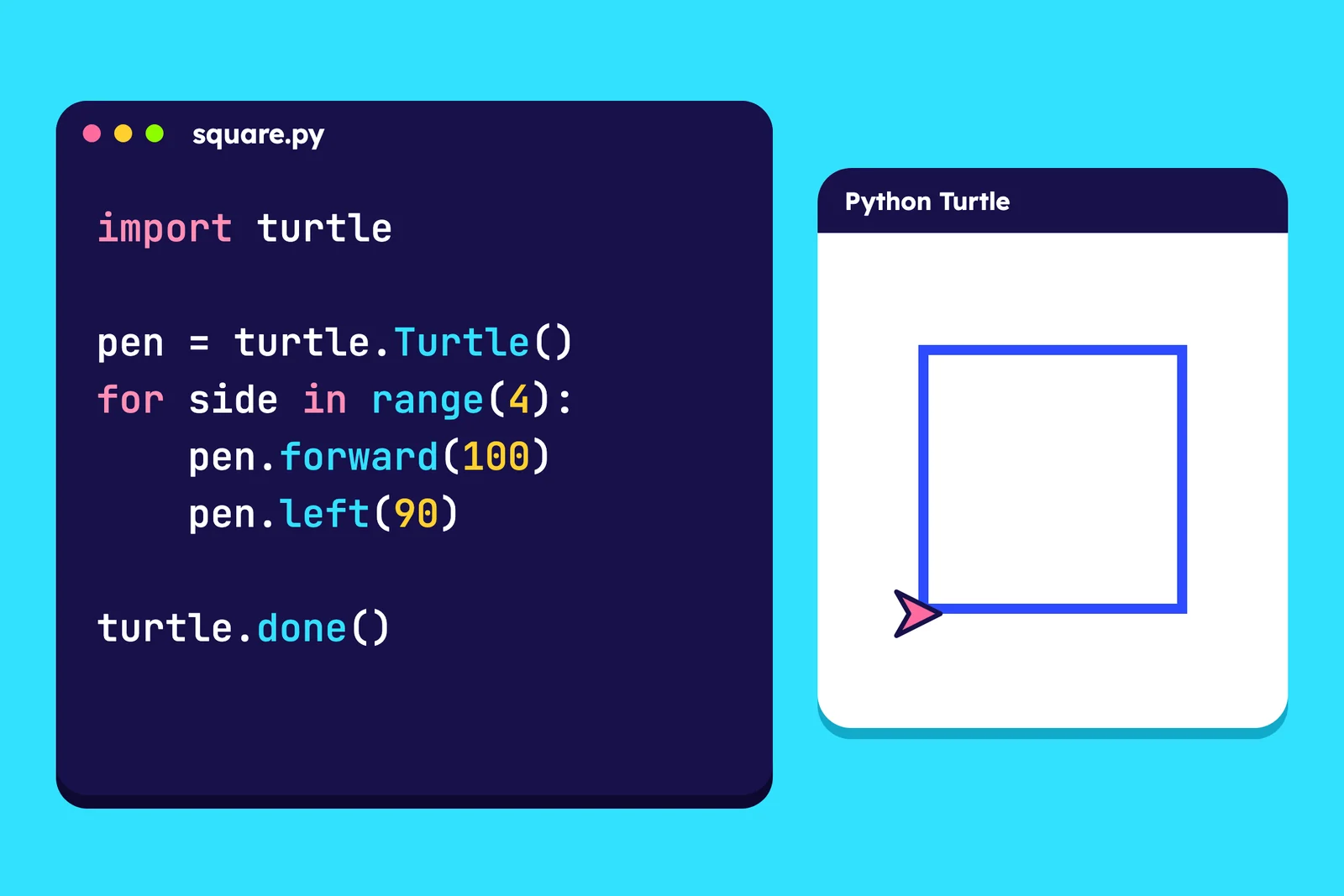
A first Python program can be six lines that draw a square on the screen. This one uses Turtle, a part of Python that moves a little pen around a window.
import turtle
pen = turtle.Turtle()
for side in range(4):
pen.forward(100)
pen.left(90)
turtle.done()
What each line does, in plain words:
import turtle gets the drawing tools ready.
pen = turtle.Turtle() makes a pen and calls it “pen”.
for side in range(4): means “do the next two lines 4 times”.
pen.forward(100) draws a line 100 steps long.
pen.left(90) turns the pen a quarter turn.
turtle.done() keeps the window open so you can see it.
Now the fun part. Change 4 to 6 and 90 to 60, and the square becomes a hexagon. Kids learn fast when they can change one number and see what happens. Level 8 projects start like this.
What kids build in Python classes, level by level
Python on the Educifly pathway runs across two levels, then leads into AI. Each level has 12 projects.

Level 8: Python Programmers I
12–15 (Grades 7–10)
Tools: Python 3, Turtle
What they make, for example: Drawings made with code, quiz games, number-guessing games
Level 9: Python Programmers II
13–16 (Grades 8–11)
Tools: Pygame, matplotlib, pandas
What they make, for example: Arcade-style games, and charts made from real data
Level 10: AI Engineers
14–17 (Grades 9–12)
Tools: OpenCV, scikit-learn
What they make, for example: AI projects written in real Python code
Level 9 also teaches kids to organise bigger programs into “objects”. That’s how professional coders keep large programs tidy.
Before Python, most kids build websites with HTML, CSS and JavaScript in Level 7. It’s their first typed code. A strong beginner can skip ahead, and the mentor decides in the free class. You can see all 13 levels on one page.
Want the AI side? See our AI classes for kids.
Should my child learn Scratch or Python first?
Most children under 10 should start with Scratch. From about 12, many beginners can go to typed code, and the mentor decides where. Scratch teaches the same big ideas with blocks, so kids learn to think like a coder before they have to type.
How you code
Drag and snap blocks
Type words and numbers
Typos
Can’t break the program, because blocks only fit the right way
One wrong letter can stop the program
Made for
Ages 8 to 16, the Scratch team says
Anyone who reads and types well
What you can make
Games, stories, animations
Games, websites, data charts, AI
Best for
A first taste of coding
The step into real code
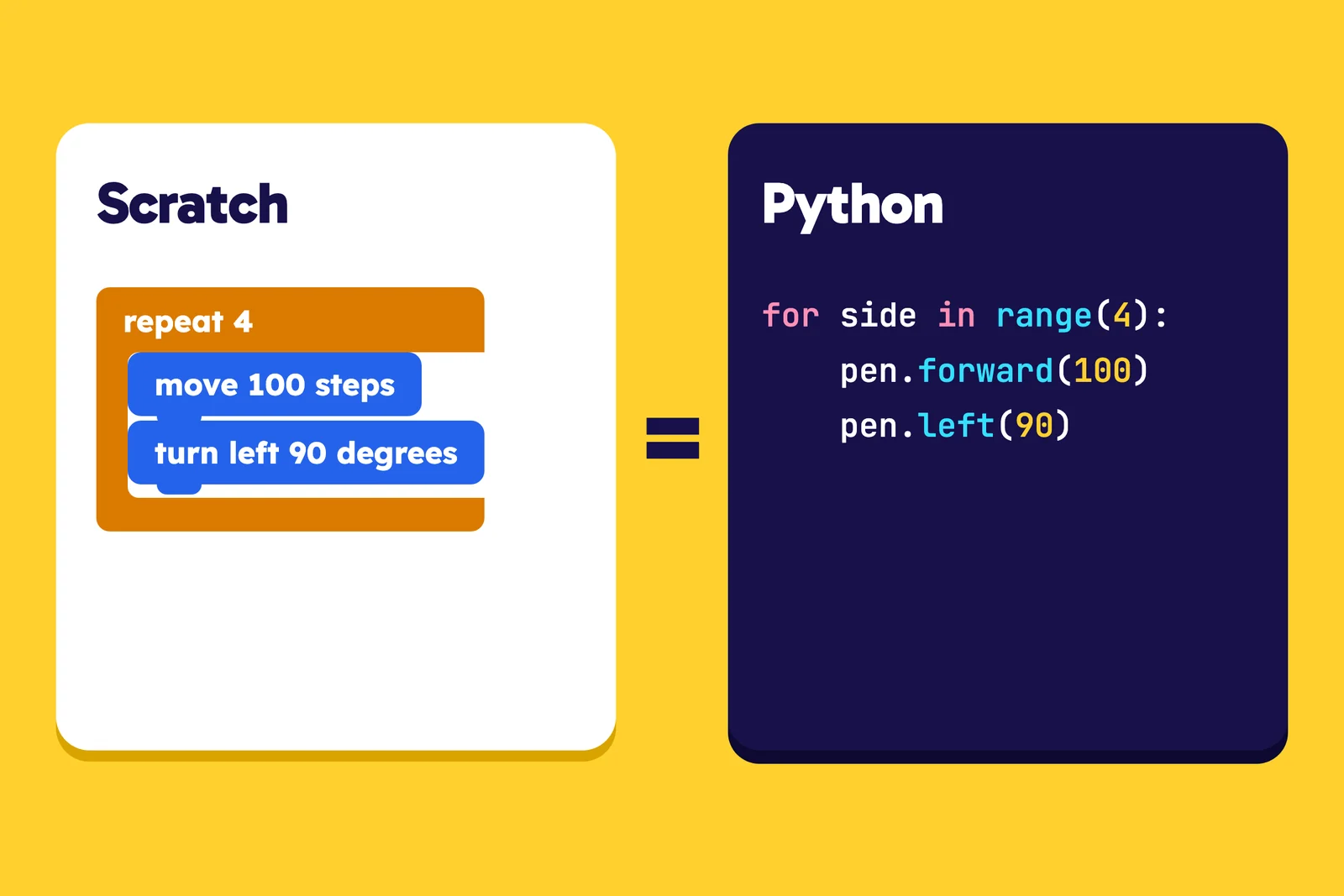
The ideas carry over. A “forever” block in Scratch is a loop in Python. A Scratch “score” is a Python variable. Kids who did Scratch first usually find Python easier.
How can I teach Python to my child at home?
You can start Python at home for free, even if you’ve never coded. This is a simple way to begin:
Download Python from python.org. It’s free and comes with IDLE, a simple place to type code.
Try the square program from this page. Then change the numbers together.
Keep it short. 20 minutes, two or three times a week, beats one long session.
Let them break things. Errors are normal. Read the error message out loud together.
Make something they care about, like a quiz about their favourite football team.
Free tools work well for kids who love to explore alone. A class helps when your child gets stuck, gets bored, or copies code without understanding it.
How do Educifly’s Python classes work?
Each class is one hour, live in Educifly’s own online classroom, with just your child and their mentor. Classes are once or twice a week, at times that suit you. It works in four steps:
1
Free trial class. In 40 minutes, your child writes a small program. The mentor sees what they can do.
2
The right level. You get a clear plan and the price. Then you decide.
3
Build something every class. Your child types the code. The mentor coaches and asks questions while your child does the typing.
4
Demo Day. At the end of the level, your child shows their big final project.
Why learn Python 1:1?
In a 1:1 class, someone helps the moment the code breaks, and your child still does all the typing. That matters most in the first weeks of Python, when one typo can stop a program.
Help when the code breaks
Straight away
None, or a forum
When the teacher is free
Pace
Your child’s pace
Your child’s pace
The group’s pace
Who types the code
Your child, with a mentor watching
Your child, alone
Your child, with less watching
Cost
Highest of the three
Lowest
In between
Who teaches the Python classes, and is it safe?
Python classes are taught by experienced coding teachers with computer science or engineering degrees. Your child keeps the same mentor for the whole level.
Every mentor is trained on the Educifly pathway and background-checked.
Classes run live in Educifly’s own online classroom.
You’re welcome to sit in on any class.
Kids learn what’s safe to share online from Level 0.
How much do Python classes for kids cost?
The Python levels are priced after a free trial class, and you see the exact price before you commit. You pay per class, and you can stop after any pack.
Free trial class
40 minutes, live and one-to-one. No payment, no card.
Python levels (8 and 9)
We share the exact price per class after the trial, before you commit to anything.
Levels 0 and 1, for younger children
₹750 a class including GST, booked in packs of 8 (₹6,000). This is our launch price, and it will go up as we grow.
Outside India
We quote you in your own currency after the free class.
Most children finish a level in 10 to 20 one-hour classes.
Who are these Python classes for?
Educifly’s Python classes are for kids from about 12, and for younger kids who are ready, from Scratch fans to teens who want to build with AI.
The Scratch kid who wants more
They’ve made Scratch games and want to know how “real” games are made.
The teen starting from zero
13 or older and never coded? They usually start with websites in Level 7 or Python in Level 8. The mentor decides in the free class.
The teen who wants to build with AI
They want to make AI projects, and Python is the way in.
The student with a portfolio in mind
They want real projects to show for school, competitions or university.
Not the right fit if your child is under 10 and hasn’t coded yet. Start with Scratch first. It’s also not for families who want a group class or a summer camp.
Questions parents ask about Python for kids
At what age should kids learn Python?
Most kids are ready for Python at about 12. On the Educifly pathway, Python is usually for ages 12 to 16. Some 10- and 11-year-olds start sooner, once they read well, can type a little and have done some Scratch.
Can a 10 year old learn Python?
Yes, if they read well and have done some block coding first. Many 10-year-olds do better with Scratch for a few months, then Python. The mentor checks this in the free class.
Is Python easy for kids?
Python is one of the easiest typed languages for kids, because it reads almost like English. The hard part is typing exactly right, since one wrong letter can stop a program. That’s why a mentor helps most in the first few weeks.
How long does it take a child to learn Python?
Most children finish one level in 10 to 20 one-hour classes. Our Python covers two levels, so the basics plus games and data take about 20 to 40 classes. Your child builds something in every class along the way.
Does my child need to know Scratch before Python?
Not always, but it helps. Scratch teaches loops, conditions and variables with blocks, so Python feels familiar. Teens new to coding usually start at Level 7 or 8, and the mentor decides in the free class.
What do we need at home?
A laptop or computer with a webcam and a steady internet connection. Python is free to download from python.org.
Is it the same mentor every class?
Yes. Your child keeps the same mentor for the whole level, so they get to know how your child thinks and where they get stuck.
Can I sit in on a class?
Yes. You’re welcome to sit in on any class, and every class is recorded.
What if it’s not working for us?
If the mentor isn’t the right fit, tell us and we’ll match your child with a new one, free. You’re never locked in. You can stop after any pack.
See your child write their first Python program in 40 minutes
Book the free class. Your child meets their mentor and writes a small program. You find the right level and get the price. Then you decide.
Usually from age 12 · Live and one-to-one · No payment needed